-
PERSEUS Interim Evaluation Report
Data Innovation Project, University of Southern Maine
The Data Innovation Project (DIP) from the University of Southern Maine’s Catherine Cutler Institute serves as the external evaluator for the USDA NIFA SAS-funded Promoting Economic Resilience and Sustainability of the Eastern U.S. Forests (PERSEUS) project. This project is a joint effort between Purdue University, the University of Georgia, and the University of Maine. The DIP supports the project in assessing its progress, implementation, and emerging impacts through data collection from project participants and systematic document review (i.e. annual USDA reports, personnel lists, and meeting notes). This includes synthesizing quantitative and qualitative data and incorporating these metrics into independent evaluation activities.
The Interim External Evaluation Report represents the first comprehensive evaluation report submitted to the leadership of the PERSEUS project. It provides an overview of evaluation activities from the first three years of the project and presents evidence of the extent to which PERSEUS is meeting its established milestones, beyond performance reporting, which is submitted to the USDA annually via REEport. The purpose of this report is to provide PERSEUS partners and the USDA with evidence of progress toward the project’s goals. The report summarizes project-wide data collection efforts, findings, and recommendations in accordance with the established evaluation questions, which are aligned with the project’s four objectives. -

Perspectives on Firearm Storage Conversations: Summary of Health Care Provider Interviews and Parent Focus Group
Rachel M. Gallo MPH
This report summarizes perspectives from Maine parents who own firearms and health care providers on safe firearm storage and related conversations in health care settings. Through interviews and a parent focus group, the project explored how firearms are stored, what influences storage decisions, and how families and providers feel about discussing firearm safety. Parents emphasized the importance of responsible ownership, education, and individualized storage solutions, while identifying cost as a key barrier to safer storage options. Many health care providers expressed interest in addressing firearm safety but cited limited time, lack of training, and concerns about patient trust as challenges. Both groups agreed that nonjudgmental, fact-based discussions focused on safety are essential. The findings highlight opportunities to strengthen firearm safety efforts in Maine through tailored training for providers, community-based education, and improved access to secure storage resources.
-
"Maine Office of Behavioral Health’s Section 17 Self-Direction Pilot Program: Evaluation Report"
Rachel M. Gallo MPH, Sarah Goan, Emma Schwartz, and Aaron Rose
Maine’s Office of Behavioral Health conducted a nine-month pilot of Self-Directed Care to support adults with serious mental illness in Cumberland, Hancock, and Washington Counties. The program allowed eligible participants receiving MaineCare Section 17 services to manage a personal budget, guided by trained Support Brokers from Alpha One, to purchase goods and services that would advance their recovery goals. The pilot aimed to increase participant choice, autonomy, and flexibility in managing their mental health needs. Support Brokers worked closely with participants and Case Managers to develop and approve individualized purchase plans, monitor expenditures, and ensure alignment with treatment objectives. A total of eighty-four individuals participated in the pilot, which is intended to inform future decisions about expanding or continuing the Self-Directed Care model in Maine. Studies suggest that this approach can improve satisfaction, autonomy, and in some cases lead to gains in employment and housing stability, highlighting its potential as an effective service delivery model.
-
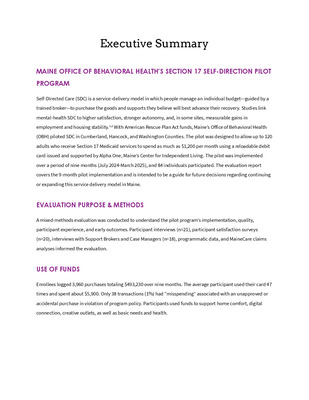
"Maine Office of Behavioral Health’s Section 17 Self-Direction Pilot Program: Executive Summary"
Rachel M. Gallo MPH, Sarah Goan, and Emma Schwartz
The Self-Directed Care (SDC) pilot program in Maine tested a service delivery model that allows individuals with mental health needs to manage a personal budget, supported by a trained broker to purchase goods and services that best support their recovery goals. Funded through the American Rescue Plan Act, the Maine Office of Behavioral Health implemented the nine-month pilot in three counties, partnering with Alpha One, Maine’s Center for Independent Living, to provide reloadable debit cards for participant purchases. The program aimed to promote autonomy, satisfaction, and stability among adults receiving Section 17 Medicaid services while informing decisions about the model’s future in the state. The evaluation used a mixed-methods design to examine implementation, quality, participant experience, and early outcomes through interviews, surveys, program data, and MaineCare claims analyses. Findings from the pilot will help guide Maine’s next steps in exploring self-directed approaches to behavioral health service delivery. A full final report is also available.
-
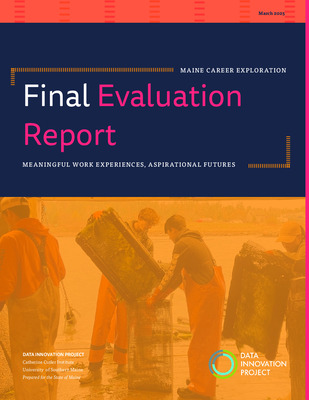
Maine Career Exploration: Final Evaluation Report
Julia Bergeron-Smith MPPM, MSW; Sarah Goan; Madison Burke; Becky Wurwarg; Amy Geren; and Shannon Saxby
The Maine Career Exploration (MCE) Program was a two-year, $25 million pilot initiative launched in 2022 by Governor Janet Mills as part of the Maine Jobs and Recovery Plan. The program aimed to connect young people aged 16 to 24 with Maine’s economy through paid, age-appropriate career experiences that matched their interests, while also expanding career exploration opportunities in schools and communities and building long-term infrastructure to sustain these efforts. Managed by the Maine Department of Economic and Community Development, MCE distributed funding across three main streams: the Maine Children’s Cabinet Career Exploration Pilot Project, the Maine Department of Education’s Extended Learning Opportunity Expansion Program, and the Jobs for Maine Graduates Career Exploration Expansion. Together, these efforts successfully exceeded participation goals, offering meaningful paid work experiences to youth across the state. The Children’s Cabinet initiative engaged disconnected and underrepresented young people, the Department of Education expanded hands-on learning programs and opportunities to earn school credit, and Jobs for Maine Graduates supported students with career readiness training and statewide coordination. The Data Innovation Project at the University of Southern Maine’s Catherine Cutler Institute conducted a mixed-methods evaluation to assess the program’s effectiveness, drawing on surveys, interviews, employer feedback, and focus groups. Findings highlighted that the program provided valuable real-world learning experiences, strengthened youth career readiness, and fostered partnerships between schools, employers, and communities. This final evaluation report expands on earlier findings to offer insights and recommendations for sustaining and growing Maine’s career exploration infrastructure in the years ahead.
-
A Retrospective Review: Oxford County Wellness Collaborative's Contributions to Community Health
Emma Schwartz and Rachel T. Gallo MPH
Since 2011, Oxford County Wellness Collaborative (OCWC) has been transforming personal, environmental, and economic health by building strong relationships among people and organizations. OCWC contracted with the Data Innovation Project at the Catherine Cutler Institute of Health and Social Policy to synthesize previously collected or reported data and collect primary data to conduct a retrospective evaluation. The evaluation team used this data to convey past successes, better understand the outcomes of the collaborative to date, and provide recommendations for OCWC’s next steps in furthering its impact.
-

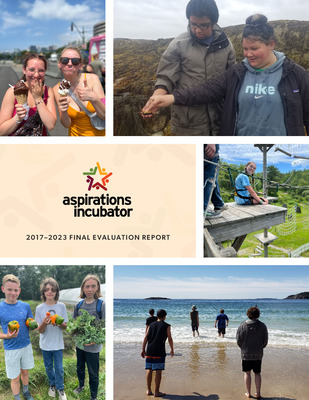
Aspirations Incubator: 2017–2023 Final Evaluation Report
Sarah Goan, Elora Way, Emma Schwartz, and Becky Wurwarg
The Rural Futures Fund launched the Aspirations Incubator in 2017 as a six-year pilot initiative aimed at supporting youth development in rural Maine by increasing resiliency, fostering connections to communities, and expanding students’ awareness of opportunities beyond their everyday environments. The program partnered with select rural youth organizations to build capacity for mentoring-based programs serving students from seventh grade through high school graduation. Guided by the Trekkers Youth Programming Principles, the initiative focused on long-term mentorship, meaningful relationship-building, and community engagement. A comprehensive multi-year evaluation conducted by the Data Innovation Project at the University of Southern Maine examined the implementation and outcomes of the program across five rural communities. Findings indicate that participation in the Aspirations Incubator contributed to students’ social and emotional growth, increased their sense of belonging, and supported the development of leadership skills. The program also exposed students to new experiences, including college and career exploration, helping them engage more deeply in their communities and inspiring them to pursue more ambitious post-secondary plans. Overall, the evaluation highlights the potential of structured, mentorship-driven programs to raise aspirations, broaden horizons, and positively impact long-term personal and educational outcomes for rural youth.
-
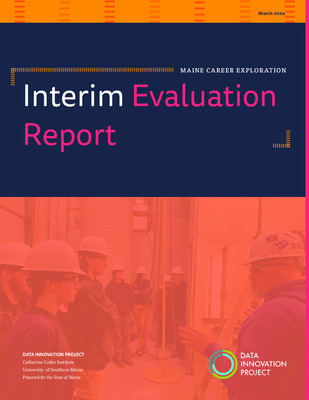
Maine Career Exploration: Interim Evaluation Report
Sydney Brown; Julia Bergeron-Smith MPPM, MSW; Sarah Goan; Madison Burke; and Becky Wurwarg
The Maine Career Exploration (MCE) Program is a two-year pilot initiative designed to connect young people with Maine’s economy through hands-on, age-appropriate career exploration experiences. Launched in 2022 with funding from Governor Janet Mills’ Jobs and Recovery Plan, the program seeks to provide meaningful paid work experiences, expand career exploration programming in schools and communities, and create sustainable infrastructure to support long-term career readiness opportunities across the state. Managed by the Maine Department of Economic and Community Development, the initiative invests in three main areas: the Maine Children’s Cabinet Career Exploration Pilot Project, the Maine Department of Education’s Extended Learning Opportunity Expansion Program, and the Jobs for Maine Graduates Career Exploration Expansion. Each of these programs focuses on engaging youth with employers, nonprofits, and public sector organizations to help them better understand career pathways aligned with their interests. Although the specific program designs differ, they share a common goal of strengthening career and educational skills in the short term while contributing to long-term workforce development. By exposing young people to real-world work experiences, MCE aims to build stronger connections between students and Maine employers, support local economic growth, and foster a more skilled and resilient future workforce.
-

Beyond 365 Days: A Retrospective Evaluation of Trekkers
Sarah Krichels Goan MPP and Madison Burke
The Trekkers program in Rockland, ME is a non-profit outdoor-based mentoring program that has served young people in mid-coast Maine since 1994. Its unique long-term mentoring model supports students over six years that begins when they are in 7th grade and continues until they graduate high school. Trekkers’ model focuses on building social, emotional and intellectual resiliency in young people through one-to-one peer mentoring, as well as the use of expeditionary learning, community service and adventure-based education. Trekkers’ programs are designed to provide an ongoing supportive network for young people in the community by connecting them with caring adults while fostering valuable life skills that help the students prepare for a happier and more successful life beyond high school graduation. In 2022, Trekkers reached out to the Data Innovation Project within the University of Southern Maine’s Catherine Cutler Institute to engage in an exploratory impact evaluation of their program model. The purpose of this report is to share the results of the exploratory analyses conducted by the research team. The report first shares the methodology, including the primary research questions, data sources, samples, and the statistical methods used to conduct the analysis. The findings of each analysis are presented, followed by a discussion of results and the implications for Trekkers, Inc., its partners, and other youth programs. The findings of this study highlight several promising results that stem from program participation, notably in terms of building resilience and relationships, and the positive outcomes that youth experience subsequently in terms of academic success.
-
Osher Map Library and Smith Center For Cartographic Education: A Five-Year Retrospective Impact Report
Elora Way, Emma Schwartz, Madison Burke, and Becky Wurwarg
Since 1994, the Osher Map Library and Smith Center for Cartographic Education (OML) has been located within the Glickman Family Library on the Portland campus of the University of Southern Maine (USM). From its inception, the OML has been charged with not only expanding and preserving its collections, but with operating in the spirit of lifelong learning and a deep commitment to engaging scholars, students (Kindergarten through higher education), educators, community partners, and the public. OML meets this charge through various strategies and activities that include: educational outreach with Kindergarten (K) through 12th grade students and university students; professional development for educators (K–12 and university); public events and exhibits; community partnerships; and the development, preservation, and digitization of collections. The Osher Map Library staff hired the Data Innovation Project (DIP) at the Catherine Cutler Institute of Health and Social Policy to design and conduct a summative evaluation of the past five years of OML’s operation, 2018–2023, in preparation for the five-year external review mandated by the 2018 Revised Operating and Display Agreement. Though there are many facets of OML’s mission to explore, this evaluation focuses on the impact of OML’s educational outreach efforts on students, faculty and educators, and to a lesser degree, the general public. The evaluation also sought to identify lessons learned and best practices, as well as recommendations and opportunities for deeper work and future collaboration.
-
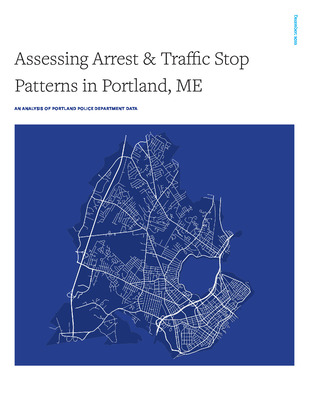
Assessing Arrest & Traffic Stop Patterns in Portland, ME
Jack McDevitt Ph.D., George Shaler MPH, Sarah Krichels Goan MPP, Stephen Abeyta, and Carlos Cuevas PhD
This project examined the available arrest and traffic citation data from Portland Police Department to determine if there is any evidence of disproportionate enforcement activities in the city.
-

"A Conceptual Framework for Measuring Criminal Justice Success in Responding to Violence Against Women Act (VAWA) Crimes: Final Results and Recommendations"
Sarah Goan, Kris Lugo-Graulich, Susy Hawes, Hannah Brintlinger MPH, and Susan Smith Howley
The Office on Violence Against Women (OVW), established under the Violence Against Women Act of 1994, leads national efforts to prevent and respond to domestic violence, dating violence, sexual assault, and stalking through 19 grant programs that strengthen victim services and enhance offender accountability. These programs include four formula grants distributed to states and fifteen discretionary programs for which OVW defines eligibility, goals, and deliverables. Grantees submit biannual progress reports containing quantitative and qualitative data that are later compiled into biennial Reports to Congress. While these reports effectively capture outputs such as numbers of victims served, trainings conducted, and partnerships formed, they provide limited information about long-term outcomes or community impact. Recognizing the need for more meaningful performance measures, OVW launched the Violence Against Women Act Measuring Effectiveness Initiative (VAWA MEI) in 2020, a collaboration between the University of Southern Maine’s Catherine E. Cutler Institute and the Justice Research and Statistics Association. The initiative was designed to develop, test, and recommend new outcome measures that would allow grantees and OVW to better assess the effectiveness of funded programs while minimizing reporting burdens. This report presents the results of that effort, focusing on three discretionary grant programs: the Improving Criminal Justice Responses Program, the Rural Program, and the Tribal Governments Program, and provides insights and recommendations for improving how OVW evaluates its nationwide work to reduce and respond to violence against women.
-
Improving Access and Health Outcomes Through CarePartners and MedAccess Programs
Elora Way and Becky Wurwarg
Access to Care, a division of MaineHealth, works to ensure that Maine residents have access to comprehensive and affordable healthcare that improves community wellbeing. In 2020, as part of its ongoing commitment to evaluating the effectiveness of its programs, Access to Care partnered with the University of Southern Maine’s Data Innovation Project to conduct a multi-year retrospective evaluation of its two longest-running initiatives, CarePartners and MedAccess. Established in 2001, CarePartners coordinates donated healthcare services for low-income, uninsured residents across six Maine counties by connecting participants with case managers, primary care providers, and pharmacy benefits. Between 2016 and 2019, 4,426 individuals enrolled in CarePartners, with a total of 7,974 enrollees supported during that period. Nearly half of those leaving the program transitioned into comprehensive insurance coverage, including Medicaid/MaineCare, Medicare, or private insurance, reflecting the program’s success in helping participants achieve more stable healthcare access. Created in 2005, MedAccess assists individuals who struggle to afford medications but do not qualify for other safety net programs. From 2013 to 2019, 7,645 people enrolled in MedAccess, and an average of 9,677 prescription assistance applications were submitted annually to pharmaceutical companies on their behalf. About half of participants exited within the first year, often aligning with the twelve-month enrollment cycle of assistance programs, and 21 percent moved on to comprehensive insurance coverage. Together, these findings highlight the critical role of Access to Care programs in bridging healthcare gaps for Maine’s most vulnerable populations and supporting long-term pathways to insurance and medication stability.
-

Aspirations Incubator: 2017–2023 Interim Evaluation Report
Sarah Goan, Elora Way, and Alexa Plotkin
The Emanuel & Pauline A. Lerner Foundation’s Aspirations Incubator (AI) is a six-year pilot initiative invested in strategic capacity building for six youth development organizations in rural Maine. Grounded in the Trekkers Youth Programming Principles, the Aspirations Incubator invests targeted resources to provide long-term, comprehensive relationship-based programming to youth. This structured yet flexible program model aims to increase resiliency and introduce new opportunities to cohorts of young people starting in 7th grade and continuing through high school graduation. To document the potential impact and effectiveness of this unique model, the Lerner Foundation contracted with the Data Innovation Project to conduct a comprehensive, multi-year implementation and outcomes evaluation. This interim report reflects the first three years (September 2017 to August 2020) of a six-year longitudinal program evaluation and details findings related to program implementation and model fidelity, and emergent participant outcomes. A final report is also available.
-
The Impact of COVID-19 on Volunteering:Results of a survey of Maine non-profits
Sarah Goan
In response to the disruptions caused by the COVID-19 pandemic, particularly within the nonprofit sector that relies heavily on volunteers, Volunteer Maine sought to assess how volunteer capacity had been affected and what types of support organizations needed to rebuild. To accomplish this, the organization partnered with DIP and SRC to design and administer a statewide survey of nonprofit organizations. The purpose of the study was to understand the pandemic’s impact on the volunteer base, document organizational adjustments to changing conditions, identify innovative responses, and determine how Volunteer Maine and its affiliates could best assist in community recovery efforts. The report summarizes findings from the survey conducted in spring 2021. It begins by describing the survey design, administration, and data preparation, followed by key results that examine the impact of COVID-19 on volunteering, changes in volunteer engagement during the pandemic, and the resources needed to restore volunteer operations
-

Portland Symphony Orchestra: PSO Explorers Program Evaluation
Susy Hawes, Sarah Goan, and Emilie Swenson MSW
In 2012, after a strategic planning process and community needs assessment, the Portland Symphony Orchestra (PSO) identified several ways the arts could better serve the community. One result was the creation of PSO Explorers, an arts integration program that brings symphony musicians into kindergarten through third grade classrooms at Portland’s Howard C. Reiche Community School and Longfellow Elementary School. The program uses music to support and enrich students’ learning in literacy, math, science, and social-emotional development by connecting musical activities with classroom lessons. PSO Explorers also helps teachers by providing ideas and skills for using the arts in their daily teaching. In 2018, PSO partnered with the Data Innovation Project at the University of Southern Maine to evaluate the program’s impact. During the 2018–2019 school year, the project team used a mixed-methods approach that combined qualitative and quantitative data from six sources, including surveys of parents, teachers, and teaching artists; teacher observation tools used in fall and spring; focus groups; and interviews. The qualitative information was analyzed through thematic and content analysis, and the quantitative data were examined using descriptive statistics in Excel and SPSS. This evaluation helped determine how PSO Explorers affected students, teachers, and teaching artists.
-
Performance Measurement in Maine’s Social Sector: The Intersection of Philanthropy and Nonprofits
Susy Hawes and Sarah Goan
The Data Innovation Project undertook this project to better understand foundations’ expectations of grantees in terms of performance measures and outcomes as outlined in their grant applications. Over the past two years, the Data Innovation Project has engaged with over 250 Maine nonprofits who are navigating the data reporting requirements of a diverse portfolio of funders with varying degrees of success and challenges. This paper looks more closely at how the important relationship between foundations and nonprofits may benefit from increased understanding and clarity around measurement approaches so that both dollars and efforts lead to meaningful and measureable results across the state, and ultimately enhance the health and well‐being of all Mainers.
Printing is not supported at the primary Gallery Thumbnail page. Please first navigate to a specific Image before printing.